Average Reviews:

(More customer reviews)I am a speech therapist, and I thnk this is a terrific, well-filmed, quality video. It is great for receptive vocabulary whether or not you much care about learning to sign! :) It has lots of repetition with REAL videos and pictures of the objects (not cartoons) and great music. It has just the right pacing to keep children excited and a nice, slow modeling of the signs with LOTS of verbal repetition of the vocabulary. My daughter loves these.
Now, my 2-year-old daughter is on the autism spectrum and did not understand how to imitate. For parents trying to help their children learn to sign, a big "tool" that I feel is "left out" of lots of videos is "HOW" to teach your child to sign if they don't seem to be learning from just watching. For young children, or children who cannot easily imitate, try "hand over hand" learning. Pick an object your child can "receive" once he learns a sign. A small cracker works great for the "eat" sign. During a snacktime when he is NOT starving, take your child's hands and make the sign for "eat" to his mouth. Then, immediately give him a piece of the cracker. Do this over and over again with repetition and SMALL bits of cracker (so he doesn't get too full). Watch that you don't wait too long on giving him the cracker or he will not learn that the sign is a part of things and he will get frustrated! :)
Now, after 10 or so repetitions, try to just hold his arm and guide his hand to his mouth to help him make the sign. After a number of more reps, try and just barely TOUCH his arm. You are gradually fading the amount of help you need to help him learn the sign. Eventually, he will go to make the sign himself. You may have to jump in and help again in a new session until he can remember the sign. This may take several days or week sessions depending on how old your child is. Be patient and try this at snack time everyday. You may be surprised how fast it happens!
You can also do this same thing with other signs once he gets the hang of things. Just be sure to FIRST choose signs that your child can receive reinforcment for. So, pick a sign like "book" where you can read to him right after he signs..or "go" where you give him a push in the grocery cart as soon as he signs. Use your child's interests as guides. Pick a sign that is relative to what HE is interested in...favorite toys or foods work great. Signs like "cat" aren't too helpful in the beginning, because what do you "get" if you sign cat? What can you give your child as reinforcement for that? Pick signs that he can use to request his needs. These work best for helping him understand that language can "get him something" and therefore "means something".
Finally, a young child (4 or younger) won't be easily able to imitate very detailed signs. You may have to modify the sign to teach it. And that is just fine! The point is not that the child can make the sign 100% correctly as it relates to American Sign Language. The REAL point is that the sign means something and that it consistently stands for that language concept. For example, for my daughter, she couldn't sign "go" which is circling your hands within each other. So, for "go" she simply raises her arm. We use it in the shopping cart at the grocery store, in the car at red lights, in the swing at the park, etc. It was her "first sign" and it helped her communicate purposefully and have a "role" in her independence. As she got the hang of it and got a bit older, I was able to teach the sign for "swing" instead of just "go". But in the beginning, a sign that can lead to a wanted action is very powerful for a child. Good luck and feel free to write if you'd like some helpful ideas!
:)Meredith [...]
Click Here to see more reviews about: My Baby Can Talk - Sharing Signs (2005)
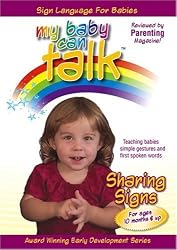
Inspiring early language development - from simple gesturesto first spoken words.Designed to encourage interaction, My Baby Can Talk - Sharing Signs teachesbabies to communicate before they can speak using sign language in a formatthat delights the senses while tapping into a baby's innate languagecapabilities. Set to classical music, My Baby Can Talk - Sharing Signstakes babies and their parents on an inspiring discovery of 28 words andsigns that are most loved by babies - including all done, apple, bath,ball, daddy, diaper, elephant, flower, help, mommy, please, share, andthank you! Honored with fourteen prestigious parenting awards and reviewed andendorsed by child psychologists, professionals in the media as well asearly childhood educators; the My Baby Can Talk series inspires preverbalcommunication as well as first spoken words and is the first programfeaturing preverbal babies signing.Research has shown that babies who usesign language tend to speak sooner with larger vocabularies, show anincrease in IQ scores and engage in more sophisticated play. The My Baby Can Talk series is specifically developed to respect thedevelopmental stage, attention span and intellect of hearing babies from 10to 36 months.This program includes a Parent Tutorial and a printed QuickReference Signing Card. MyBabyCanTalk.com is the premier resource center on the Internet forbabies and signing featuring detailed tutorials, background research, and avideo dictionary with more than 200 ASL signs that are most important toand appropriate for babies and toddlers.
 Get 12% OFF
Click here for more information about My Baby Can Talk - Sharing Signs (2005)

0 comments:
Post a Comment